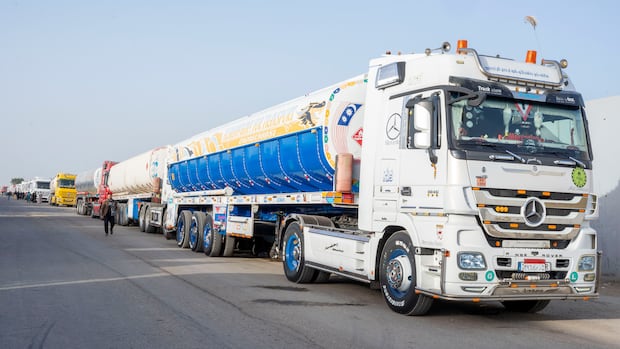

For Palestinians in Gaza, the Rafah border crossing to Egypt is their gateway to the world. But since Israel seized it in May 2024, it has been largely closed.
Today, Israeli Prime Minister Benjamin Netanyahu said the crossing would reopen soon, as the U.S.-brokered ceasefire plan between Israel and Hamas enters its second phase.
It raises hope for thousands of war-wounded Palestinians seeking to travel abroad for medical treatment, and for tens of thousands of people outside Gaza seeking to return home.
“Everyone in Gaza, from families whose children are urgently awaiting medical evacuation, to students who have scholarships abroad, to others who are separated from their families, are all desperately watching what is happening at the Rafah border crossing,” Alexandra Saieh, head of global strategic influence and policy at the humanitarian organization Save the Children, told CBC News.
But those hoping to cross will be subject to strict controls. Under the conditions stipulated by Netanyahu, only dozens of Palestinians will be allowed to cross the crossing each day, and no goods will pass through for now. All other Gaza border crossings are with Israel.
An Israeli official who spoke to The Associated Press on condition of anonymity in accordance with policy said the Rafah crossing would open in the coming days. A person close to the reopening discussions said he was told it could happen as early as Thursday.
Ali Shaath, newly appointed head of the Palestinian administrative committee governing Gaza’s daily affairs, said on January 22 that the crossing would “open next week in both directions.”
“The opening of Rafah means that Gaza is no longer closed to the future and to the world,” he said in a video released by the White House on X last week.

Humanitarian organizations call for better access to essential goods
Preparations are underway to allow a limited number of medical evacuees to leave Gaza first.
There are conflicting reports on how many people can cross each day. The Israeli official said 50 Palestinians would be allowed in and 50 out daily. The person familiar with the discussions said 50 people would be allowed in daily and 150 out.
That means a long wait for many of the 20,000 sick and injured who the territory’s health ministry says need treatment outside Gaza, where Israeli attacks have devastated the health system.
At the rate of 50 evacuations per day, it would take more than a year for each of these 20,000 people to leave.

One specific rule is to prevent Palestinian students already accepted into Canadian universities from entering the country.
Saieh told CBC News that Israel’s plan to control who comes in and out is “incredibly concerning” but “unsurprising,” and Save the Children is calling on the Israeli government to allow unfettered access.
She hopes the opening will also increase the humanitarian aid the country desperately needs, from basic medical aid to basic shelter supplies. Palestinians have also long reported vast shortages of fuel and other essential goods.
Save the Children is also calling for the opening of a medical corridor between Gaza and East Jerusalem, where hospitals could accommodate people requiring medical evacuation.
“The opening of Rafah should be unconditional,” Saieh said. “People should have the right to freedom of movement, and unfortunately this has been denied to Palestinians in Gaza.”
Meanwhile, at least 30,000 Palestinians have registered with the Palestinian embassy in Cairo to return to Gaza, according to an embassy official, speaking on condition of anonymity because details of the reopening remain under discussion.
The United Nations wants the crossing to be open “to both humanitarian goods and private sector goods, which is of crucial importance for the revival of the economy in Gaza,” spokesperson Stéphane Dujarric said on Wednesday.
U.N. Deputy Middle East Coordinator Ramiz Alakbarov told a U.N. Security Council meeting that aid workers were facing “delays and refusals to deliver goods at crossing points and limited routes available to transport supplies inside Gaza.”
Several countries, institutions involved
A complex network of countries and institutions will oversee the Rafah crossing, but Israel controls who enters and who leaves.
Egypt will provide Israel with a daily list of names to review and decide on, the Israeli official said.
Under the terms of the ceasefire, the Israeli army controls the area between the Rafah crossing and the area where most Palestinians live. COGAT, the Israeli military body responsible for coordinating aid to Gaza, will transport Palestinians to and from the crossing, the official said.
There will be no Israeli soldiers at the crossing, the official said, but Palestinians entering and leaving will be subject to Israeli security screening inside Gaza. In the past, such checks have been carried out by Israeli soldiers and private American contractors.

Andrew Chang explains what a billion US dollars can buy for members of Trump’s new Peace Council. Images provided by The Canadian Press, Reuters and Getty Images
“Everyone entering or leaving is subject to our inspection, a complete inspection,” Netanyahu said Tuesday.
Officers from the EU Border Assistance Mission and the Palestinian Authority will manage the crossing.
Plainclothes Palestinian Authority agents will stamp the passports, as they did during a brief ceasefire in early 2025 and before Hamas took control of Gaza in 2007, Palestinian officials told The Associated Press.
The crossing has long been a subject of contention
Even before the war, Palestinians faced heavy restrictions in Rafah.
Egypt, alongside Israel, imposed a blockade after Hamas seized power in Gaza in 2007. It reopened the crossing after Egypt’s 2011 revolution, but closed it in 2013 after the army ousted President Mohammed Morsi, a leader of the Muslim Brotherhood, the Islamist movement from which Hamas emerged.
Egypt gradually allowed the Rafah crossing to reopen in the years that followed, but intermittent restrictions led to a massive tunnel economy that sprung up underneath.
The tunnels have served as an economic lifeline for Gaza and a channel for transporting weapons and money, according to Israeli and Egyptian officials. Hamas collected taxes and customs duties on goods passing through the crossing point.
Netanyahu said he was focused on disarming Hamas, a difficult part of the second phase of the U.S.-brokered ceasefire, and destroying its remaining tunnels. He said there would be no reconstruction in Gaza without demilitarization, a position that could make Israeli control over the Rafah crossing a key lever.