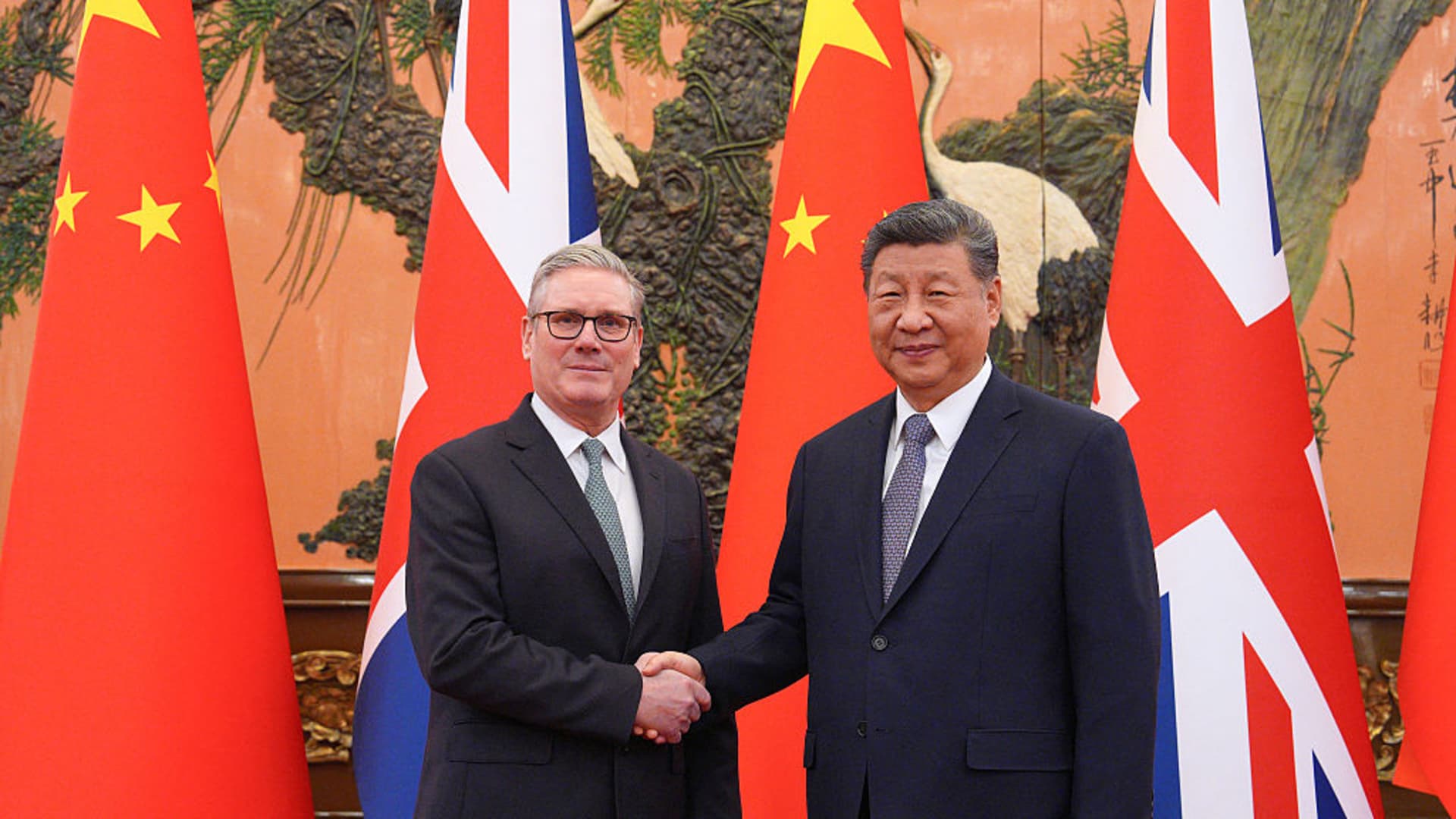

Chinese President Xi Jinping (R) and British Prime Minister Keir Starmer shake hands before their meeting at the Great Hall of the People in Beijing on January 29, 2026.
Carl Court | Afp | Getty Images
BEIJING — Countries that shunned China during its trade dispute with the United States are now sending their leaders to Beijing to meet with Chinese President Xi Jinping — and are eager to strike trade deals.
At least five national leaders, including British Prime Minister Keir Starmer and Canadian Prime Minister Mark Carney, visited Xi in January alone. Uruguayan President Yamandú Orsi is scheduled to make the trip next week – the first by a South American leader since US President Donald Trump captured Venezuelan leader Nicolás Maduro and his wife in early January.
The trips by the Canadian and British leaders are the first in at least eight years, while the Irish Prime Minister’s visit on January 5 was the first in 14 years. China had closed its borders during the Covid-19 pandemic and only seriously reopened them in early 2023.
“These visits reflect controlled and selective resets amid growing political uncertainty in the United States, rather than a strategic pivot toward China,” said Yue Su, senior economist at the Economist Intelligence Unit.
“Keeping open channels of communication with Beijing is increasingly seen as preferable to disengagement,” she said, “especially as gains from selective resets with China become more visible and U.S. policy has become less predictable.”
Since taking office 12 months ago, Trump has imposed tariffs not only on China but on a slew of the United States’ trading partners. In recent months, he has stepped up efforts to increase American influence over Venezuela, Iran And Greenland.
This is an opportunity for Beijing, which seeks to present itself not only as a partner for developing countries, but also as a stabilizing force for the world.

“Maintaining their distance from the United States indicates that these countries value their ties with China’s large economy,” Cui Shoujun, professor of international studies at Renmin University of China, said in a telephone interview on Thursday. That’s according to a CNBC translation of his Mandarin remarks.
European and other countries may still have to align with the United States on security issues, but they are now increasing their economic engagement, Cui said.
Facilitate commercial transactions
Large business delegations often accompany national leaders on state visits. Nearly 60 British businesses and cultural organizations sent representatives to accompany the British Prime Minister on his trip to China. British pharmaceutical giant AstraZeneca took advantage of the state visit to announce its intention to invest 15 billion dollars in China by 2030.
Likewise, during Carney’s visit, Canada agreed reduce prices on a limited number of Chinese-made electric cars from 100% to 6.1%, in exchange for lower Chinese tariffs on Canadian canola seeds.
Global companies have also long wanted to sell their products to China’s vast consumer market, the second largest in the world.
For their part, Chinese leaders urged visiting countries to create a fair environment for Chinese companies operating or investing locally. Many Chinese companies, such as electric car makers, have accelerated their global expansion plans as domestic growth slows.
Beijing has increasingly clearly expressed its efforts to build technological self-sufficiency and maintain itself on the world stage.
Earlier this month, the head of the ruling Chinese Communist Party’s international affairs department wrote in the official party newspaper that China’s modernization efforts break a “Western-centric” model and offer a new choice to developing countries.
US-China relations retain their influence
But the overarching question remains that of tensions between the world’s two largest economies. Some of the visiting countries still count the United States, not China, as their largest trading partner.
The five countries visited by the leaders in January – Ireland, South Korea, Canada and Finland – have a combined gross domestic product of $8.71 trillion, less than half of China’s GDP of $18.74 trillion, according to the report. World Bank figures for 2024. The United States remained much larger, with a GDP of $28.75 trillion.
China was the first major economy to retaliate against Trump’s “Liberation Day” tariffs in April 2025. The two countries agreed a fragile one-year trade truce in late October, and Trump is expected to visit China in April.
The American Chamber of Commerce in China organized a thank-you dinner in Beijing on Thursday evening, during Starmer’s visit, attended by representatives of the Chinese side. In his opening remarks, President James Zimmerman urged Trump and Xi to create a vision for greater global stability.
The opportunity for the two leaders to meet up to four times this year marks “a moment of lasting leadership and meaningful progress that should not be missed,” Zimmerman said.

Subscribe now
One opportunity for Trump and Xi to meet — and draw other world leaders to China — is the Asia-Pacific Economic Cooperation forum, which China is hosting this year. The APEC forum is expected to hold a meeting of senior officials in the southern Chinese city of Guangzhou early next month, ahead of the top economic leaders’ meeting in November.
But visiting leaders still need to strike a balance when dealing with China.
This week, Trump threatened to impose 100% tariffs on Canada if Ottawa “makes a deal” with China and I said it was “very dangerous” for Britain do business with China. A nod to the interests of European industry, French President Emmanuel Macron threatened China with tariffs a day after returning from his state visit in December.
“These trips are a hedging strategy,” said Jack Lee, a foreign affairs analyst at consultancy China Macro Group.
“They are keeping the China channel open in order to preserve strategic optionality,” he said. But he warned that trust, particularly between the EU and Beijing, remains limited.