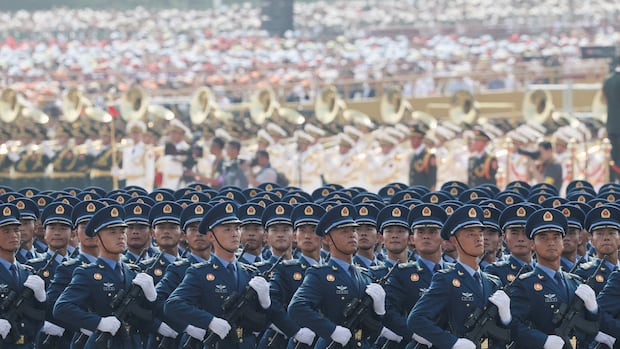

The surprise ouster of China’s highest-ranking general shakes up the world’s largest military and leaves the future of the Central Military Commission uncertain after years of sweeping purges by Chinese President Xi Jinping.
The ensuing investigation into Zhang Youxia — who was vice-president of Central Military Commission (CMC), the military body that oversees the People’s Liberation Army (PLA) with its two million men — leaves Xi almost alone at the head of the army.
Although no one outside the leadership knows for sure what led to the unprecedented crackdown, it raises questions about how the military will operate in the future and what it could mean for regional stability, including China’s views on Taiwan.
“This is a Shakespearean moment in Chinese politics,” said Jonathan Czin, a former senior China analyst at the CIA who spent two years as China director on the U.S. National Security Council.
On January 24, China’s Defense Ministry announced that Zhang and Liu Zhenli, another high-ranking general and CMC member, were under investigation for “violations of discipline and law,” reducing the corps from seven to two, including Xi.
The next day, the Liberation Army Daily, the official newspaper of the armed forces, published an editorial accusing Liu and Zhang of corruption and betraying “the trust and expectations” of the Chinese Communist Party, emphasizing that “no one, regardless of rank or position, will be spared.”

“Ruthless with your friends”
If anyone seemed immune, it was Zhang. After all, he and Xi have a long history. Their fathers served together during China’s civil war that led to the seizure of power by Mao Zedong’s communist forces in 1949. Zhang and Xi, who had known each other since they were young, were also friends and allies.
“It’s one thing to be ruthless to your enemies. It’s another thing to be ruthless to your friends,” said Czin, a foreign policy expert at the Brookings Institution in Washington, D.C., who notes that the only clear message to emerge from Zhang’s investigation is “there is no safe zone” in Xi’s anti-corruption campaign.

Although the reasoning behind the dismissal remains unclear, with the party’s machinations notoriously opaque, the move cements Xi in an “unassailable position,” said Ja Ian Chong, assistant professor of political science at the National University of Singapore.
“Much more will depend on the top leadership. Much more will depend on Xi’s likes and dislikes,” he said.
Since coming to power in 2012, Xi has adopted radical reforms of the PLA in order to make it a modern force, in particular by fighting corruption. Zhang was one of the people chosen to lead this transformation.
Most recently, 10 Central Committee officials were expelled during the Fourth Plenum of the Chinese Communist Party in October, most of whom were military.
For many, the investigation into Zhang has a different impact than previous purges, given his long-standing ties to the president.
Some China watchers suspect that corruption is not the main motivation, but rather a sign of an attempt by Xi to consolidate power, said Kevin Luo, an assistant professor at the University of Minnesota Twin Cities in Minneapolis who focuses on Chinese and authoritarian politics.
Luo said streamlining the chain of command and ensuring the party has the ability to “command the arms” are the driving forces behind this move, thereby exerting Xi’s control over all party apparatuses, including military and political institutions within the party.
“It’s more about maintaining discipline, making sure people are on the same page,” he said.
The Taiwan question
Whatever the motivations, the military undoubtedly faces a lot of “uncertainty,” other observers said.
Shanshan Mei, a political scientist at the RAND Corporation think tank in Washington, DC, who focuses on monitoring the leadership and organization of the PLA, said this latest move will have a “ripple effect throughout the armed forces.”
“It’s a big blow to morale [of] troops,” she said, arguing that the purge could block Xi’s views on Taiwan, given that the military’s command structure has been upended.
Mei said any military move in Taiwan would not be good timing for China “when you have just caused huge disruption.”

China’s top military leadership is being restructured and reduced to just two members. The move concentrates control of the People’s Liberation Army in the hands of Chinese President Xi Jinping and a military general – and the shift is drawing worldwide attention.
Some, like Drew Thompson, a former China specialist at the Pentagon, who recently wrote an article on Substack During the week he accompanied Zhang on a visit to the United States in 2012, Zhang urged caution before seizing the island, considering he was one of the few military leaders to witness combat, having fought in the Vietnam War.
“I believe he was the only active-duty PLA officer who could give Xi the best and most objective advice on the PLA’s military capabilities, including the PLA’s shortcomings and, importantly, the human cost of the military conflict,” Thompson wrote.
As a result, Zhang’s ouster could be seen as a step toward removing that caveat.
Czin, of the Brookings Institution, said the PLA is large enough that a leadership shakeup would not affect its operational capacity, emphasizing that the December military exercise around Taiwan, following the latest plenary purges.
“It’s a big enough organization that they can walk and chew gum at the same time,” he said.
The problem is that it is still unclear who will be in charge of the PLA’s day-to-day operations now that Zhang is gone.
WATCH | Xi Jinping strengthens his power in China:

Chinese President Xi Jinping appears ready to retain his post for an exceptional third term after consolidating his power for several years. CBC News takes a closer look at the power dynamics at play and what Xi’s consolidated power could mean for the rest of the world.