

Listen to this article
About 5 minutes
The audio version of this article is generated by AI-based technology. Pronunciation errors may occur. We work with our partners to continually review and improve results.
Federal prosecutors cannot seek the death penalty against Luigi Mangione for the killing of UnitedHealthcare CEO Brian Thompson, a judge ruled Friday, foiling the Trump administration’s attempt to have him executed for what it called a “premeditated, cold-blooded assassination that shocked America.”
U.S. District Judge Margaret Garnett dismissed the federal murder charge against Mangione, finding it technically flawed. She wrote that she did so to “exclude the death penalty as an available sentence for consideration by the jury” in evaluating whether to convict Mangione.
Garnett also dismissed a gun charge, but left in place stalking charges that carry a maximum sentence of life in prison. In order to seek the death penalty, prosecutors had to show that Mangione killed Thompson while committing another “crime of violence.” Harassment does not fit this definition, Garnett wrote in his opinion, citing case law and legal precedent.
In a victory for prosecutors, Garnett ruled that prosecutors could use evidence collected from his backpack during his arrest, including a 9mm handgun and a notebook in which authorities say Mangione described his intention to “wax” an insurance executive.
Mangione’s lawyers had sought to exclude those items, arguing the search was illegal because police had not yet obtained a warrant.
The decisions could be appealed. A message seeking comment was left with a spokesperson for the U.S. attorney’s office in Manhattan, which is prosecuting the federal case.
Garnett acknowledged that the decision “may seem tortured and strange to the average person – and even to many lawyers and judges – and that the result may seem contrary to our intuitions about criminal law.”
But, she said, it reflects her “determined efforts to faithfully apply the precepts of the Supreme Court to the charges in this case.” The law must be the sole concern of the Court.”

A federal judge in New York has dismissed the murder charge against Luigi Mangione, accused of killing UnitedHealthcare CEO Brian Thompson in 2024. U.S. District Judge Margaret Garnett ruled that the charge was technically flawed. Mangione will still face federal stalking and firearms charges, as well as a separate state murder charge.
Mangione pleaded not guilty
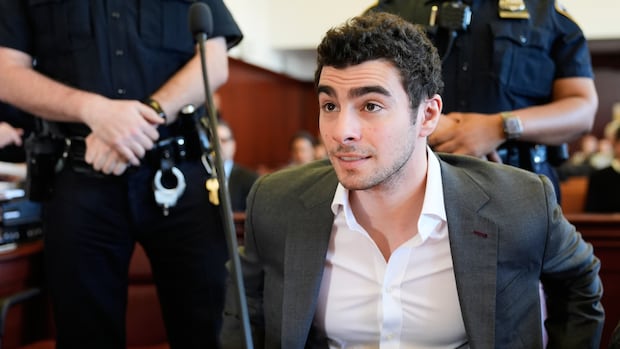
Mangione, 27, appeared relaxed as he sat with his attorneys during a brief hearing scheduled about an hour after Garnett issued his written ruling. Prosecutors retained their right to appeal the decision but said they were ready to proceed to trial.
Mangione’s lawyers did not discuss the decision during the hearing. But his lawyer, Karen Friedman Agnifilo, said afterward that her client and his defense team were relieved by the “incredible decision.”
Jury selection in the federal case is scheduled to begin September 8, followed by opening statements and testimony beginning October 13. The state trial has not yet been scheduled. On Wednesday, the Manhattan District Attorney’s Office sent a letter urging the judge in the case to set a trial date for July 1.
Thompson, 50, was killed Dec. 4, 2024, while walking to a midtown Manhattan hotel for UnitedHealth Group’s annual investor conference.

Surveillance video shows a masked gunman shooting him from behind. Police said “delay,” “refuse” and “drop” were written on the ammunition, mimicking a phrase used to describe how insurers avoid paying claims.
Mangione, an Ivy League graduate from a wealthy Maryland family, was arrested five days later at a McDonald’s in Altoona, Pennsylvania, about 230 miles west of Manhattan.
Following Donald Trump’s campaign promise to vigorously pursue the death penalty, Attorney General Pam Bondi last April ordered federal prosecutors in Manhattan to seek the death penalty against Mangione.
It was the first time the Justice Department sought to introduce the death penalty during Trump’s second presidential term. He returned to power a year ago with a promise to resume federal executions after they were halted under his predecessor, Joe Biden.
“Based on politics, not merit”
Garnett, a Biden appointee, ruled after a flurry of prosecution and defense court filings in recent months. She held oral arguments on the issue earlier this month.
In addition to seeking to have the death penalty dropped on the grounds cited by Garnett, Mangione’s lawyers argued that Bondi’s announcement flouted long-established Justice Department protocols and showed the decision was “based on politics, not merit.”
They said his remarks, which were followed by posts on his Instagram account and a television appearance, “indelibly damaged” the grand jury process that resulted in his indictment weeks later.
Prosecutors urged Garnett to keep the death penalty on the table, arguing that the charges allowing such punishment were legally sound and that Bondi’s remarks were not prejudicial because “pretrial publicity, however intense, is not itself a constitutional defect.”
Rather than dismissing the case outright or barring the government from seeking the death penalty, prosecutors argued, the best way to assuage the defense’s concerns would be to carefully question prospective jurors about their knowledge of the case and ensure that Mangione’s rights are respected at trial.
“What the defendant characterizes as a constitutional crisis is merely a restatement of arguments” rejected in previous cases, prosecutors said. “There is no basis for dismissal of the indictment or categorical exclusion of a sanction authorized by Congress.”