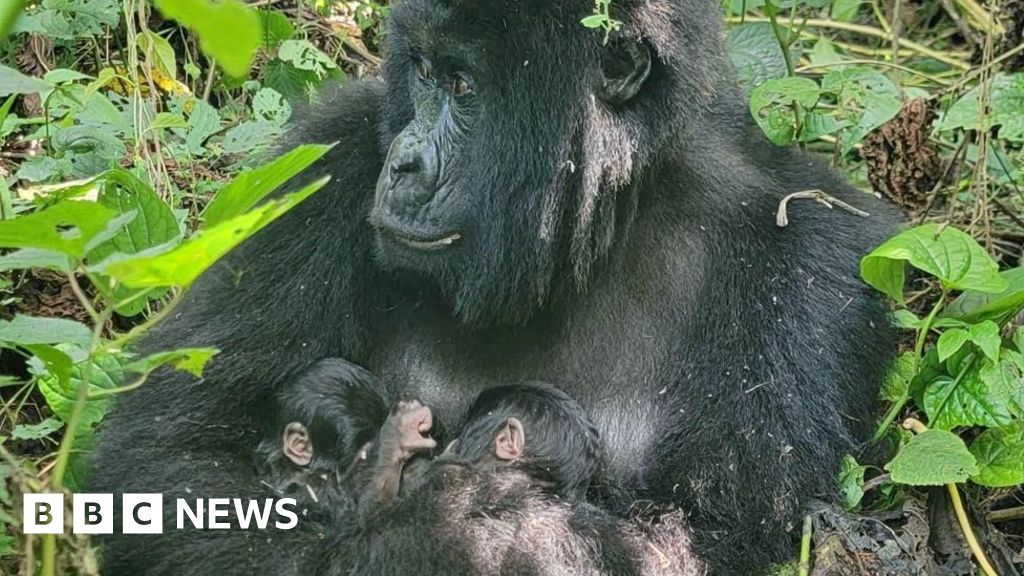

A pair of twin mountain gorillas have been born in eastern Democratic Republic of Congo – a rare phenomenon for these endangered primates, conservationists in Virunga National Park say.
Community investigators, who discovered Mafuko, 22, clutching her newborns in her arms on Saturday, said the mother and her two baby sons all appeared healthy.
Twin births are estimated to account for about 1% of all mountain gorilla births, although exact data are not widely available.
Virunga, located in a conflict-prone region of the Democratic Republic of Congo, is Africa’s oldest and largest national park. It was created 100 years ago to protect mountain gorillas, of which there are fewer than 1,100 individuals left in the wild.
They are only found in Virunga and in the national parks bordering Rwanda and Uganda, according to the International Union for Conservation of Nature (IUCN), which draws up a Red List of threatened species.
The last birth of twin mountain gorillas born in Virunga National Park was in September 2020.
Mafuko herself gave birth to twins in 2016, but they both died within a week.
Young gorillas are entirely dependent on their mothers for care and transport – and are extremely vulnerable in what can be a dangerous environment where poachers and many armed groups operate.
Park authorities say additional monitoring and protection measures have been put in place to ensure the twins’ survival during this critical period.
Rangers would closely observe the young family and provide support if necessary, they said.
A gorilla’s pregnancy lasts about eight and a half months, and females typically give birth to a baby every four years.
According to Virunga conservationists, Mafuko herself had a remarkable survival story.
Born in 2003 into the Kabirizi family, she lost her mother to armed attackers when she was four years old.
She joined the Bageni family at the age of 10, and to date, she has been pregnant and given birth five times.
Conservationists in Virunga, which is a UNESCO World Heritage site, say its latest offspring represent a significant boost to efforts to protect endangered species.
Thanks to anti-poaching patrols and community programs – supported by the European Union and UNESCO – the number of mountain gorillas in Virunga has slowly increased over the past decade.
This success, documented by the IUCN and other partners, led to their status being changed from “critically endangered” to “endangered” in 2018.
Virunga spans 7,800 square kilometers (3,000 square miles) and is home to a surprisingly diverse landscape – from active volcanoes and vast lakes to rainforest and mountains.